|
| Venice Home | All topics |
| Where to stay | Transportation |
 Helping
30+ million
Venice travelers since 1997
New in 2024:
Venice's tourist "access fee"
Helping
30+ million
Venice travelers since 1997
New in 2024:
Venice's tourist "access fee"
Helping
30+ million
Venice travelers since 1997
New in 2024:
Venice's tourist "access fee" |
|
Venice's GhettoThe oldest ghetto in Europe has five synagogues, a Jewish museum, shops, two inns, and a kosher restaurant.
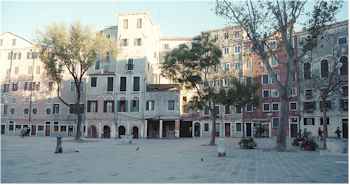
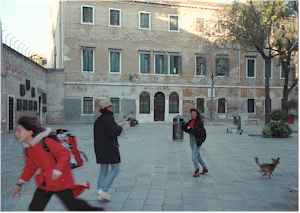
ABOVE: The Campo del Ghetto Nuovo, or "New Ghetto," in Venice, Italy. Despite the name, it was founded earlier than the adjacent Ghetto Vecchio ("Old Ghetto").
Today, the word "ghetto" has a negative connotation, being associated with modern urban slums and the persecution of Jews in Central Europe during the Nazi era. But in 1516, when an enclosed neighborhood for Jews was created in Venice, "ghetto" referred to the foundry that the district replaced. What's more, the intention wasn't to persecute Jews per se: The Venetian Republic segregated its Jews to placate the Roman Catholic Church, which had already forced the expulsion of Jews from much of Western Europe. The Ghetto both isolated and protected the Jewish residents of Venice who lived within its walls. In The Venetian Ghetto, Bernard Dov Cooperman writes:
Cooperman adds:
Life in Venice's Ghetto
ABOVE: Façade of the Scuola Italiana, or Italian Synagogue, in the Ghetto Nuovo. The Venetian Ghetto was a crowded place, with a population that grew as Jews and conversos (Jews who nominally had converted to Catholicism) came to Venice from other countries of Europe and the Mediterranean. By the mid-1600s, Jews controlled much of Venice's foreign trade, and it wasn't long until immigrant Jewish physicians, lawyers, and scholars played important roles in the daily business of the Venetian Republic. During the day, Jews were allowed to leave the Ghetto to work and play throughout Venice. Gates were locked at nightfall and guarded by watchmen who were paid by the Jewish community. (In practice, the law wasn't always enforced, and it wasn't uncommon for young Jewish men to party after dark in the Catholic areas of the city.) As the population increased, more space was added by annexing the neighboring Ghetto Vecchio, or "Old Foundry" area in 1641 for Levantine Jews (some from the Ottoman Empire, others descendants of Jews who had been expelled from Spain and Portugal in 1492.) Apartment densities were increased by adding floors and, where necessary, lowering ceilings in existing houses. Some buildings reached six stories--an unprecedented height for Venice. Yet despite the amount of housing that was crammed into the Ghetto's modest boundaries, there wasn't enough sleeping space for the estimated 5,000 Jews who lived in the district before the European plague of 1630 that killed a third of Venice's population. Daily activity in the Ghetto was both colorful and lively. In Venice and Environs: Jewish Itineraries, the authors write:
ABOVE: Modern street life in the Campo Ghetto Nuovo. (The plaques of a memorial to Venetian holocaust victims are barely visible on the wall at left.) Ethnic rivalries and synagoguesThe Ghetto may have been populated by Jews, but it wasn't a melting pot. Residents came from a variety of countries, cultures, and social classes, making clashes (or at least open hostility) inevitable. This was most obvious in the building of synagogues, which eventually numbered five: one each for the German, Italian, Spanish, and Levantine communities, and a fifth--the Scuola Canton--which may have been French, or may have created as a private synagogue for the families who undewrote its building expenses. (All five synagogues remain. Three may be visited on a public tour, and two others--both in the Ghetto Vecchio--are used for religious services on an alternating summer and winter schedule.) Freed by Napoleon, persecuted by HitlerAs Venice went into economic and political decline in the 1700s, the Ghetto sank with it and was forced to declare bankruptcy in 1737. Sixty years later, Napoleon's troops brought an end to the Republic of Venice. The Ghetto's gates were torn down, and Jews were given the same freedoms as other citizens of Venice. Many Jews chose to continue living in the Ghetto, however, and the Ghetto remained a focal point for the Venetian Jewish community until the German occupation during World War II, when some 200 Jews were deported and killed between 1943 and 1945. Rebirth of the GhettoThe Jewish community in Venice has experienced a modest rebirth in recent years. About 500 Jews live in Venice, although the Ghetto itself has only about 30 Jewish residents. Religious services take place in either the Scuola Grande Spagnola or the Scuola Levantina. The neighborhood has several Jewish shops, a book publisher, a social center, a rest home for the elderly, a museum, a yeshiva, and a kosher restaurant (run by Lubavicher Jews whose rabbi came to Venice after 20 years in Bologna).
Tip:
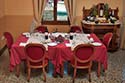
Where to stay and dine in Venice's Ghetto You'll find two hotels on the Campo del Ghetto Nuovo:
A short walk away, next to the Cannaregio Canal, is the Gam Gam kosher restaurant. Gam Gam has Venetian, Italian and Israeli dishes on its extensive menu. You can dine in or order meals for takeout or delivery to your hotel. (See our Gam-Gam restaurant review.) Reaching the Ghetto
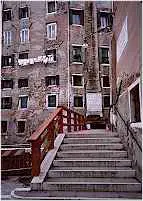
ABOVE: Bridge to the Campo Ghetto Nuovo from the Calle Farnese in Cannaregio. Walk or take the vaporetto (water bus) to the Guglie stop on the Fondamenta di Cannaregio, just above the Ponte delle Guglie bridge. You'll see a low rectangular arched doorway next to the Gam Gam restaurant. Go through the arch, and you'll be in the Ghetto Vecchio. Keep on walking to reach the larger (and older) Ghetto Nuovo, where you'l also find the Jewish Community Museum. If you're coming on foot from the Piazza San Marco or Rialto, you can turn right from the Rio Terà S. Leonardo or the Rio Terà Farsetti and work your way toward the Calle Farnese and its bridge (see photo above). Or, if you're coming from the Madonna dell'Orto Church or its vaporetto stop, head west on the Fondamenta degli Ormesini until you see a small footbridge leading to the Campo Ghetto Nuovo. Web links
Virtual Jewish
World: Venice, Italy
Wikipedia:
History of the Jews in Venice
The
Ancient Jewish Cemetery at The Lido of Venice Jewish Venice
Related Venice for Visitors articlesGam Gam Locanda del Ghetto Madonna dell'Orto Church About the author:
|
|
| Venice for Visitors - Home | | Europe for Visitors - Home | | About our site | | Press clippings | | Testimonials | Copyright © 1996-2024 Durant and Cheryl Imboden. All rights reserved. |

 Tours
of the Ghetto are available year-round at the Museo Ebraico
(Jewish Museum) in the Campo Ghetto Nuovo, which has a large
collection of religious objects and silverware. The tour has several morning and
afternoon departures and lasts about 40 minutes. The price is a bit steep, but
the three synagogues included in the tour are worth visiting if you're even
remotely interested in Venetian history or Jewish culture. (You can also buy a
combined ticket for the tour and the museum.)
Tours
of the Ghetto are available year-round at the Museo Ebraico
(Jewish Museum) in the Campo Ghetto Nuovo, which has a large
collection of religious objects and silverware. The tour has several morning and
afternoon departures and lasts about 40 minutes. The price is a bit steep, but
the three synagogues included in the tour are worth visiting if you're even
remotely interested in Venetian history or Jewish culture. (You can also buy a
combined ticket for the tour and the museum.)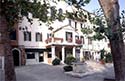
 The
The